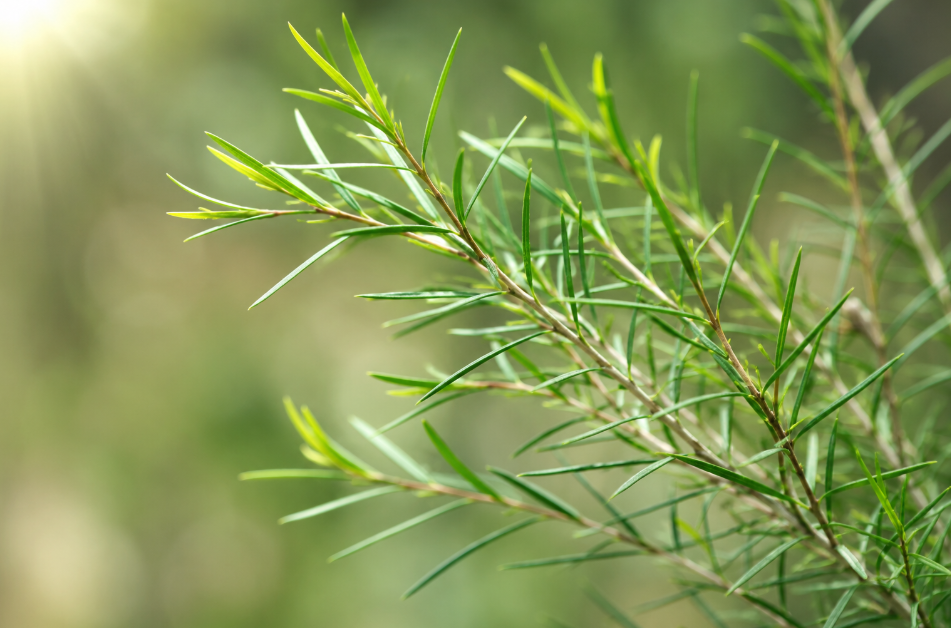
Tea tree oil (TTO) is steam distilled from the leaves of Melaleuca alternifolia, a tree native to the coastal lowlands of New South Wales, Australia. Aboriginal Australians used the plant for many generations, and European-led laboratory study of its antimicrobial properties began in the 1920s. It is one of the more familiar essential oils on the market today and is included in many natural skincare and household products.
Chemical Composition
High-quality tea tree oil contains over 100 compounds. The key therapeutic constituents include:
- Terpinen-4-ol (30–48%) — the primary antimicrobial agent; disrupts microbial membranes
- γ-Terpinene (10–28%) — antioxidant, anti-inflammatory
- α-Terpinene (5–13%) — antioxidant activity
- 1,8-Cineole (0–15%; ISO standard max 15%) — antimicrobial, but potentially irritating at higher concentrations
- α-Terpineol (1.5–8%) — antimicrobial, anti-inflammatory
- p-Cymene (0.5–8%) — antimicrobial, analgesic
Antimicrobial Mechanisms
The antimicrobial activity of tea tree oil is primarily attributed to terpinen-4-ol and its ability to disrupt the structural and functional integrity of microbial cell membranes. The mechanism is well-characterized:
- Terpinen-4-ol intercalates into phospholipid bilayers of bacterial and fungal cell membranes
- This disrupts membrane fluidity and permeability
- Ions and ATP leak out, disrupting chemiosmotic gradients
- Essential enzymatic functions dependent on membrane integrity fail
- Cell lysis and death follows within minutes to hours depending on concentration
This non-specific membrane-targeting mechanism is significant because it is very difficult for microorganisms to develop resistance against — unlike the specific enzyme or receptor targets of conventional antibiotics.
Activity Against Specific Organisms
| Organism | Type | MIC Range | Evidence Level |
|---|---|---|---|
| MRSA (methicillin-resistant S. aureus) | Bacterium | 0.25–2% | Strong (in vitro + clinical) |
| Candida albicans | Fungus | 0.5–1% | Strong (in vitro + clinical) |
| Trichophyton spp. (athlete's foot) | Dermatophyte | 0.1–0.5% | Strong (clinical RCTs) |
| E. coli (ESBL-producing) | Bacterium | 0.5–2% | Moderate (in vitro) |
| Streptococcus pyogenes | Bacterium | 0.25–1% | Moderate (in vitro) |
| Propionibacterium acnes | Bacterium | 0.25% | Strong (clinical RCTs) |
| Herpes simplex virus (HSV-1) | Virus | 0.0009–0.001% | Moderate (in vitro) |
| Influenza A virus | Virus | 0.001–0.01% | Limited (in vitro) |
| Demodex mites | Parasite | Various formulations | Strong (clinical) |
Reported Topical Uses (Educational Overview)
The list below is a plain-English summary of how tea tree oil has been studied or traditionally used. Outcomes vary widely between studies, and tea tree oil is not an FDA-approved treatment for any condition. None of the items below should be interpreted as medical advice or a substitute for professional care.
Acne (Acne Vulgaris)
Dilute tea tree preparations (often around 5%) have been studied as a topical adjunct for mild acne. Results in published research vary; some trials report improvement in lesion counts, with slower onset and a different side-effect profile compared to common conventional treatments.
Onychomycosis (Nail Fungus)
Tea tree oil has been studied as a topical option for nail fungus, often in combination with other ingredients. Reported results are mixed — some participants improved, while others required conventional antifungal treatment.
Tinea Pedis (Athlete's Foot)
Higher-concentration tea tree solutions have been evaluated for athlete's foot in small clinical trials, with some reports of symptom reduction compared with placebo.
MRSA Decolonization
Tea tree preparations have been compared with the standard topical antibiotic mupirocin in MRSA decolonization studies. Outcomes vary by trial design; in at least one well-known comparative study, mupirocin was more effective than tea tree for nasal clearance, while tea tree performed better than the comparator at certain skin sites. Tea tree is not a substitute for prescribed infection control protocols.
Demodex Blepharitis (Eyelid Mites)
Tea tree-based eyelid cleansers and in-office lid treatments have been incorporated into some ophthalmology practices for Demodex-associated blepharitis. Speak with an eye-care professional before using any tea tree product near the eyes — DIY application is not recommended.
Safety Profile
Tea tree oil has an excellent safety profile when used topically at recommended concentrations. Key safety points:
- Dilute properly: 5% or less for general skin use; 1–2% for sensitive skin or children
- Avoid ingestion: TTO is toxic when swallowed — even small amounts can cause serious neurological effects
- Oxidation risk: Old or improperly stored TTO becomes more irritating — store in dark glass, away from heat and light
- Eye safety: Avoid direct eye contact; exceptions are formulated eyelid products specifically designed for periorbital use
- Pets: Toxic to cats and dogs — avoid diffusing or applying where pets are present
Selecting Quality Tea Tree Oil
The composition of essential oils varies widely between brands. When shopping for tea tree oil, look for these general label cues:
- Terpinen-4-ol ≥ 30% (verify via GC/MS report)
- 1,8-Cineole ≤ 15%
- Sourced from Australia (native growing region)
- Botanical name: Melaleuca alternifolia (not M. quinquenervia, which is different)
- Produced within 2 years (oxidation increases over time)
Our high-quality essential oils include tea tree oil that meets ISO 4730 standards and is verified by third-party GC/MS analysis — giving you the confidence that you're getting the oil the research actually studied.
Summary
Tea tree oil is one of the more familiar essential oils used topically in personal care. Researchers continue to study its activity against various bacteria and fungi, and ISO 4730 provides a chemical-composition standard for the oil. As with any essential oil, dilute before topical use, patch-test on a small area, avoid the eyes, never ingest, and keep it away from pets — especially cats and dogs.
This article is for educational purposes only and is not medical advice. Essential oils are not intended to diagnose, treat, cure, or prevent any disease. Consult a qualified healthcare provider for medical concerns.